
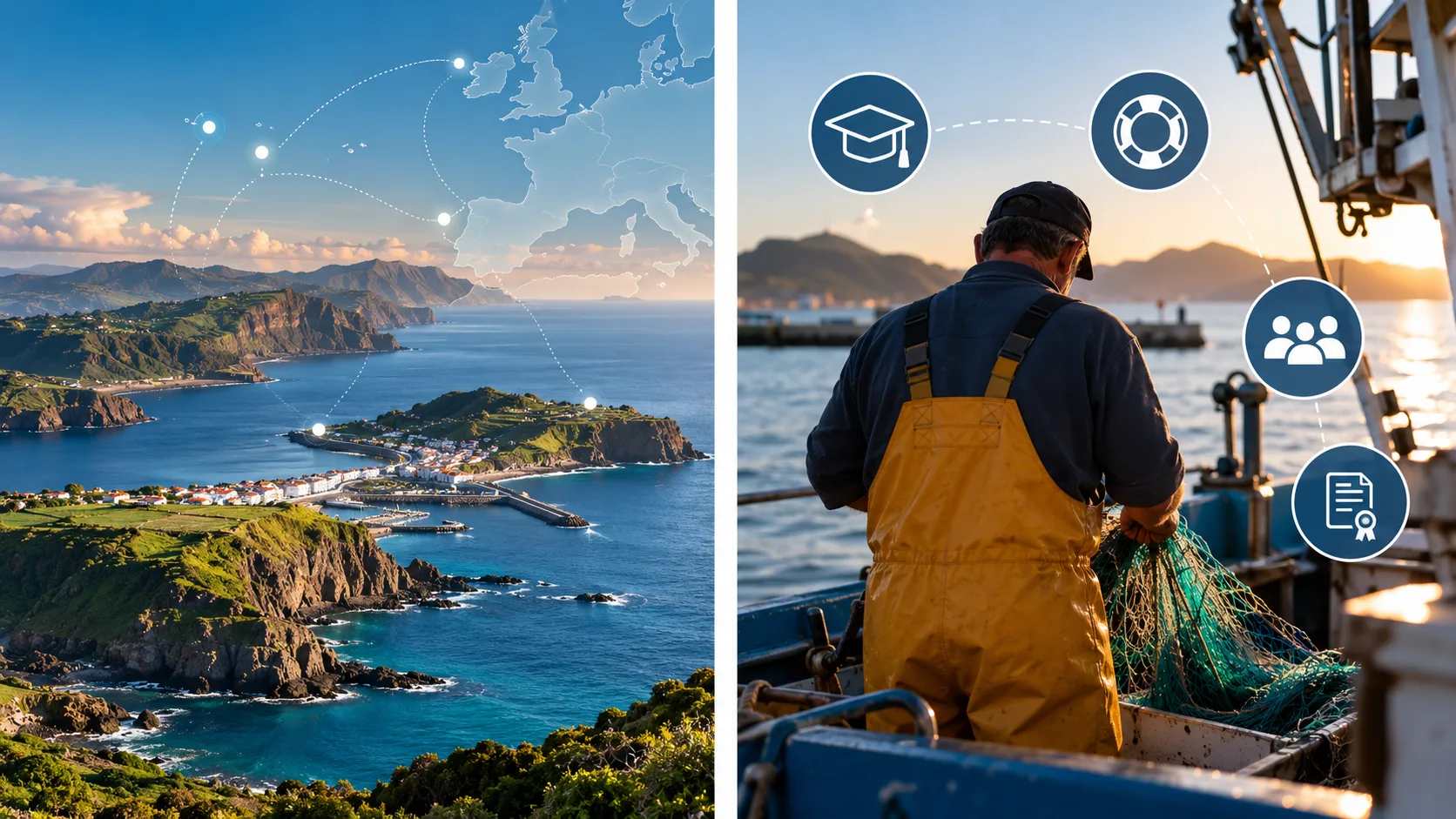
In its official contribution to the European Commission, INSULEUR warns that uniform training requirements could place disproportionate burdens on small-scale island fisheries and calls for flexible, accessible and fully supported solutions.
INSULEUR – Network of Insular Chambers of Commerce of the European Union has formally submitted its position to the European Commission’s Call for Evidence on “Training and certification standards for fishers on EU vessels”, calling for a regulatory framework that improves maritime safety while safeguarding the viability of small-scale fisheries across Europe’s islands.
The Network’s contribution, submitted on 16 October 2026 and published on the European Commission’s Have Your Say platform, underlines the need to ensure that harmonised European standards reflect the specific geographical, economic and social realities of island fishing communities.
Addressed to the Commission’s Directorate-General for Maritime Affairs and Fisheries (DG MARE), the submission welcomes the objectives of improving safety at sea, strengthening the attractiveness of the fishing profession and facilitating workforce mobility.
However, INSULEUR raises serious concerns that the indiscriminate application of harmonised training requirements, particularly those based on the International Maritime Organization’s STCW-F Convention, could have disproportionate consequences for fishers operating in remote and outermost island regions.
One European framework, different island realities
For many European island communities, small-scale coastal fishing is far more than an economic activity. It supports local employment, preserves traditional livelihoods and contributes to the social and economic fabric of remote territories.
Yet island fishers operate under conditions that differ considerably from those of large-scale commercial fleets.
INSULEUR highlights several structural obstacles:
- Limited access to training facilities: Many islands lack specialised maritime training centres, forcing fishers to travel to the mainland.
- Disproportionate financial burdens: Travel, accommodation and time away from fishing activities create significant additional costs.
- Demographic pressures: An ageing workforce and difficulties attracting younger generations already threaten the continuity of the profession.
Against this background, INSULEUR warns that additional administrative and financial obligations could accelerate the decline of small-scale fishing and further weaken vulnerable island communities.
INSULEUR calls for a proportionate regulatory approach
In its contribution, INSULEUR takes a clear position on the policy options under consideration by the European Commission.
The Network opposes Policy Option 4, which would extend mandatory basic training requirements to all vessel sizes, including skippers of vessels under 24 metres.
INSULEUR warns that such an approach could impose excessive financial and administrative burdens on small-scale island fleets, potentially forcing fishers to abandon the profession.
Instead, INSULEUR supports Policy Option 3, subject to the introduction of specific safeguards for island fisheries. This approach would preserve the possibility for Member States to exempt vessels under 24 metres from basic training requirements.
The Network maintains that mandatory standards should primarily target large-scale and distant-water fleets, while requirements for smaller coastal vessels should remain voluntary or be substantially adapted to their operating conditions.
Four concrete proposals to protect island fishers
To ensure that improved safety standards do not jeopardise the future of small-scale fisheries, INSULEUR puts forward four specific recommendations:
1. Flexible and decentralised training
Introduce online learning for theoretical modules and mobile training units that can periodically deliver practical instruction, including firefighting and first aid, directly on islands.
This would significantly reduce the need for costly travel and improve access to essential safety training.
2. Full financial support
Ensure that training fees, travel and accommodation expenses, and compensation for lost income are covered at 100% through the European Maritime, Fisheries and Aquaculture Fund (EMFAF).
INSULEUR stresses that the financial burden of new requirements should not fall on small-scale island fishers who already face significant structural disadvantages.
3. Recognition of professional experience
Introduce provisions recognising the extensive practical experience of established island fishers and skippers, avoiding unnecessary retraining obligations.
Professional experience acquired over many years should be recognised as equivalent to basic training for eligible small-scale fishers.
4. Simplified standards for coastal fisheries
Develop shorter, practical training modules tailored to the actual risks faced by small-scale coastal fishers, rather than imposing requirements designed for large ocean-going vessels.
Such an approach would maintain essential safety objectives while ensuring proportionality and accessibility.
Making island-proofing a priority in EU maritime policy
A central demand of INSULEUR’s submission is the systematic application of an island-proofing approach to the assessment and development of new European legislation.
The Network stresses that harmonisation must not overlook the geographical and economic realities of island territories.
While improved safety at sea remains an essential objective, European rules must be proportionate, accessible and adapted to the specific needs of the communities they are intended to serve.
INSULEUR therefore calls on the European Commission to explicitly assess the potential impacts of new training obligations on small-scale island fleets, particularly in remote and outermost regions.
Protecting safety, livelihoods and the future of island communities
Through this formal contribution to the European Commission’s consultation process, INSULEUR continues its policy advocacy on behalf of European island businesses and local economies, seeking to ensure that EU maritime legislation reflects the practical realities of insularity.
The Network calls on the European Commission to incorporate island-specific safeguards into the forthcoming legislative framework and to ensure that small-scale fisheries are not disproportionately affected by new regulatory obligations.
The message is clear: Improving safety at sea must go hand in hand with protecting the livelihoods, competitiveness and long-term sustainability of Europe’s island fishing communities.
🔗 Read INSULEUR’s official contribution on EU training and certification standards for fishers