
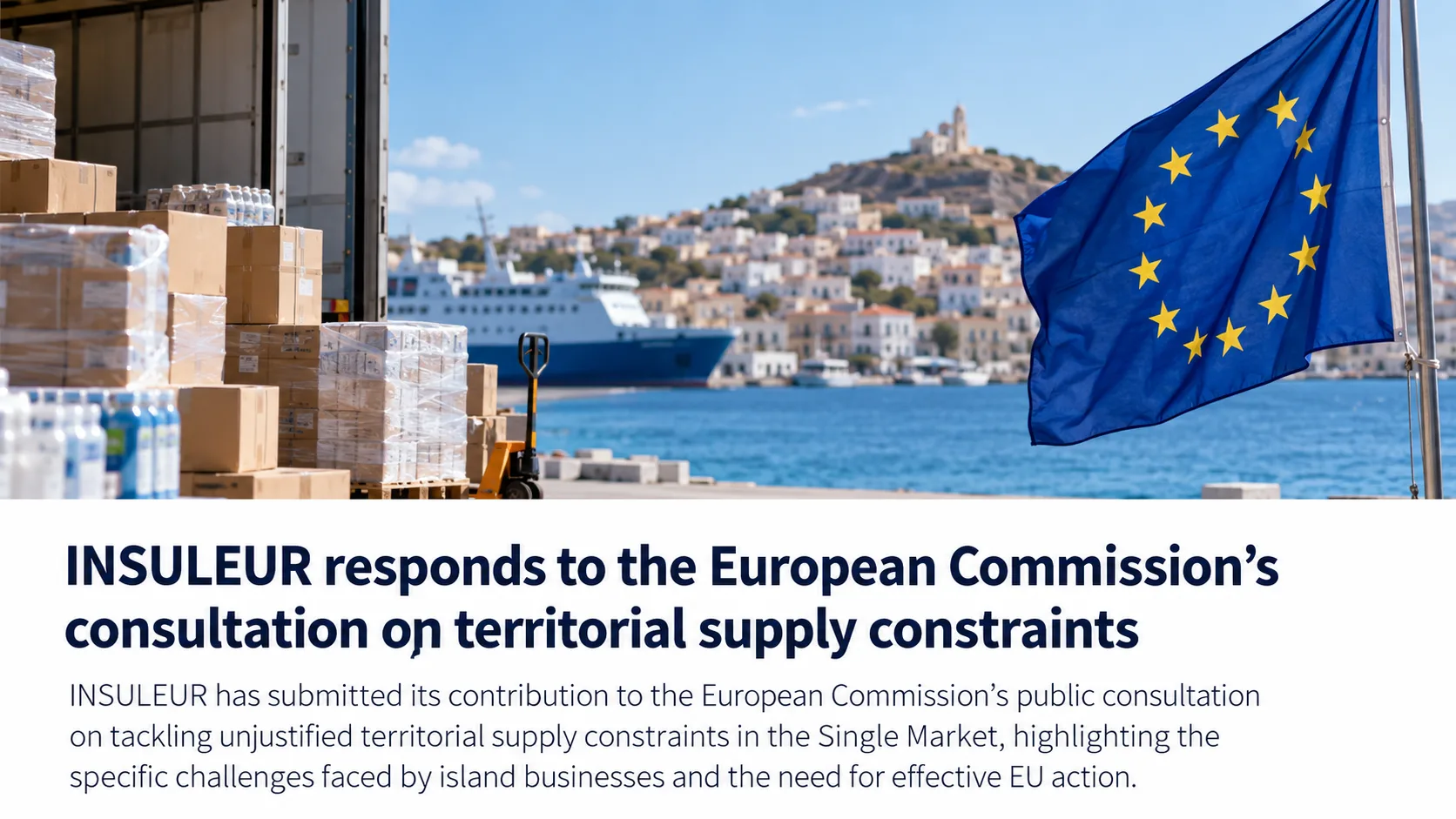
INSULEUR has submitted its contribution to the European Commission’s public consultation on Territorial Supply Constraints (TSCs), calling for enforceable EU measures to eliminate unjustified barriers to cross-border sourcing and ensure that island businesses and consumers can fully benefit from the Single Market.
Territorial Supply Constraints are commercial practices that prevent or restrict retailers and wholesalers from purchasing products in one EU Member State for resale in another. Such practices can limit competition, reduce consumer choice and contribute to price differences across the European Union.
For island economies, these restrictions are particularly damaging. Businesses already face structural challenges, including higher transport costs, smaller markets, limited supplier choice and dependence on external distribution networks. Unjustified supply restrictions add another layer of difficulty, further undermining the competitiveness of island SMEs and increasing costs for consumers.
INSULEUR Advocates Clear and Enforceable EU Rules
In its contribution, INSULEUR expresses strong support for EU legislation identifying prohibited territorial supply practices and clearly defining the circumstances in which restrictions may be objectively justified.
The network considers this approach essential to providing legal certainty and enabling island businesses to source goods from the most competitive markets across the EU.
INSULEUR also supports complementary European Commission guidelines to ensure consistent interpretation and enforcement across Member States.
While recognising the potential contribution of voluntary codes of conduct and legislation based on economic dependence, INSULEUR considers these approaches insufficient on their own, particularly for island SMEs with limited bargaining power and resources to challenge restrictive practices.
Addressing the Double Burden Faced by Islands
A central message of INSULEUR’s contribution is that island businesses and consumers face a double burden: unavoidable costs associated with insularity, compounded by artificial commercial barriers that further restrict access to competitive markets.
The network also highlights the interaction between territorial supply restrictions and physical transport limitations.
Evidence gathered through INSULEUR’s member Chambers shows how seasonal pressures on ferry capacity can delay the transport of essential goods and retail supplies. Even where cross-border sourcing is legally possible, limited freight capacity and disruptions to maritime connections can prevent products from reaching island markets efficiently.
Removing unjustified commercial restrictions must therefore go hand in hand with measures supporting reliable maritime and air connectivity, adequate freight capacity and resilient island supply chains.
Linking Single Market Reform to EU Cohesion and Island Policies
INSULEUR stresses that tackling Territorial Supply Constraints should also contribute to the EU’s wider territorial cohesion objectives.
In particular, the network calls for the specific circumstances of islands to be recognised in line with Article 174 of the Treaty on the Functioning of the European Union (TFEU), which provides for special attention to territories facing permanent geographical disadvantages.
Fair access to goods, competitive prices and reliable supply chains are essential not only for the viability of island SMEs but also for the long-term economic and demographic resilience of island communities.
INSULEUR sottolinea quindi l'importanza di collegare l'azione contro i Vincoli di Approvvigionamento Territoriale alla politica di coesione dell'UE, alle iniziative di competitività delle PMI e alle iniziative emergenti Strategia del Diritto di restare.
Con questo contributo, INSULEUR riafferma il suo impegno nel garantire che le sfide specifiche delle isole europee si riflettano nella formulazione delle politiche dell'UE ed è pronta a fornire ulteriori prove ed esperienza dalla sua rete di Camere delle isole.
Leggi di più:
Commissione Europea – Consultazione pubblica sui Vincoli di Approvvigionamento Territoriale